
On October 3, 2026, I attended a human tower competition in Tarragona. Eighteen teams took part in the Saturday session of the 30th Concurs de Castells, held once every two years. These towers, known as castells, are a Catalan tradition inscribed on UNESCO’s list of intangible cultural heritage in 2010.
The venue was Tarraco Arena, a former bullring. Participants crowded the entire circular arena, their green, light blue, yellow, red, and pink shirts forming great blocks of color. Each team entered behind musicians playing the high-pitched gralla and drums. Before the competition, everyone sang together and shouted, “Long live Catalonia!” The local people’s pride in their homeland added to the excitement in the arena.
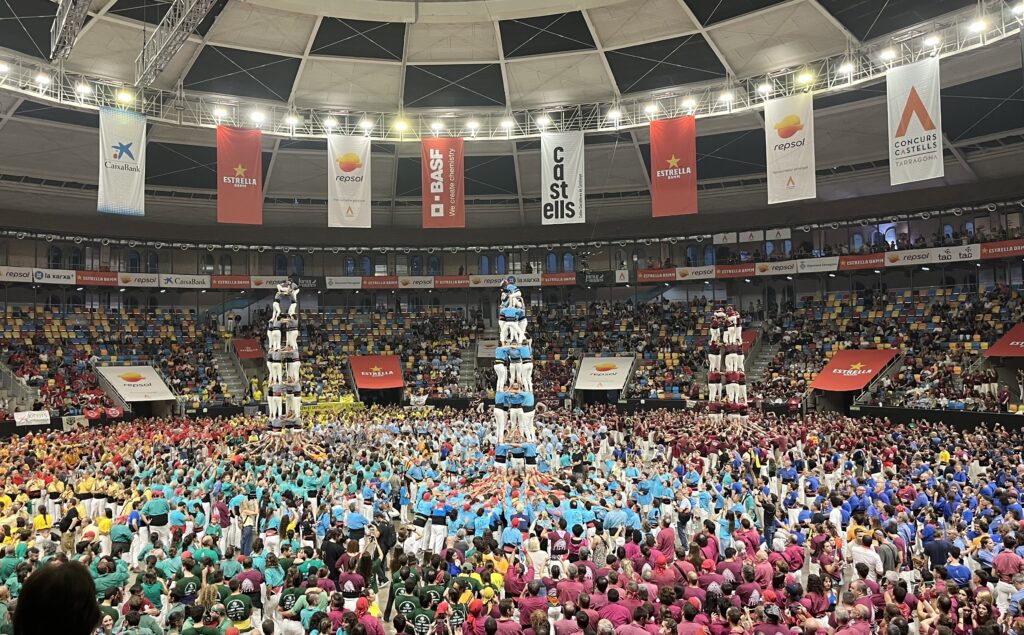
Teams in a kaleidoscope of colors gather as several towers rise from the arena floor
Everyone wore a black sash around the waist. One person held taut a strip of cloth that looked about five meters long, while the wearer leaned their weight against it and turned round and round to tighten it. It reminded me of wrapping a traditional Japanese sarashi cloth around the torso. The sash not only supports the body; it also provides handholds and footholds for climbers, like the rungs of a ladder.
The tallest towers that day had eight levels. Finally, a child who looked about six or seven years old raised a hand at the top. The arena, so loud that a ringing phone would have been inaudible, became focused as a tower began to rise. The voice directing the climbers, the gralla heightening the tension. Even neighboring rival teams watched with bated breath, and everyone applauded together, whether the tower was safely completed or collapsed partway through. Yet what caught my attention most this time was the base beneath it.
In this base, called the pinya, people press their bodies together in layer upon layer. They fit beneath arms and into the smallest gaps, forming rows that push toward the center. The leader carefully checked who would stand where and whom each person would support. Strength came not simply from the number of people, but from how they were positioned.
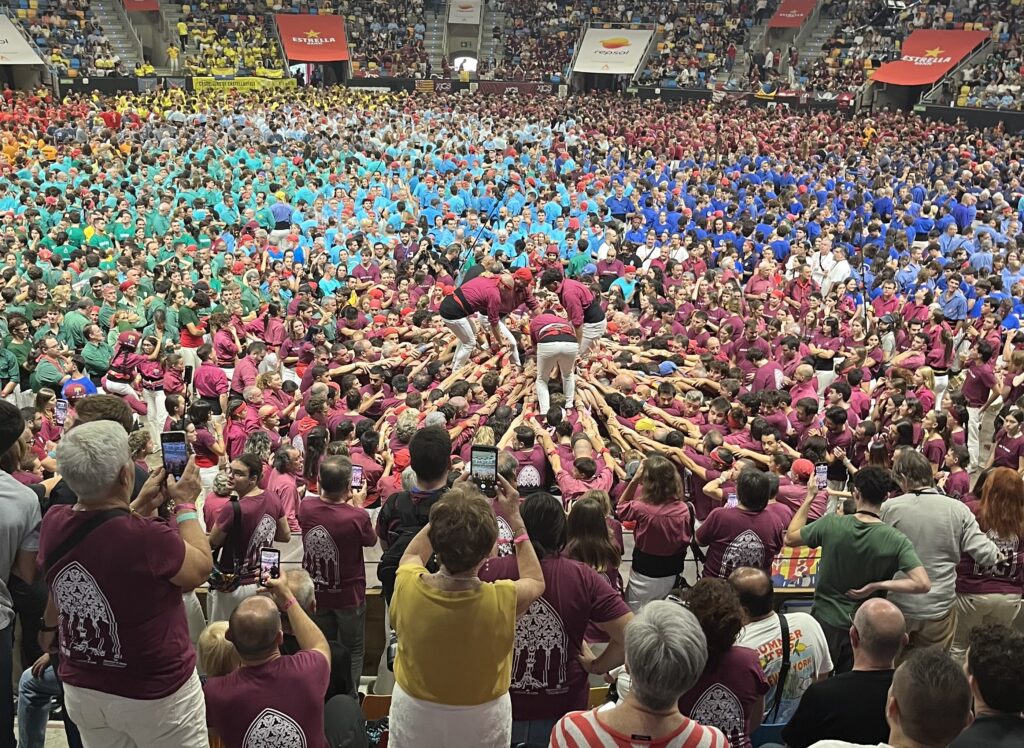
The tightly packed base: bodies pressed together and arms layered toward the center
The base also serves as a safety net, cushioning the impact when a tower collapses. I witnessed two collapses that day. Those receiving the falling climbers face danger too. That must be why it matters so much to leave no gaps and to align bodies and arms with the people around them.
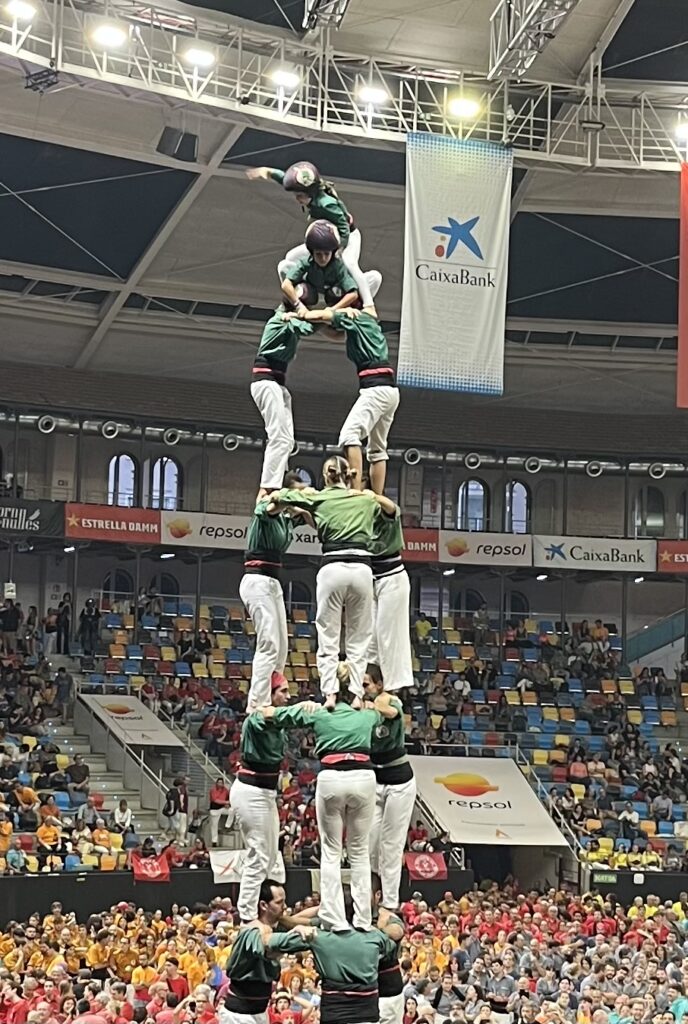
The child raises a hand at the top, marking the moment the tower has been built
In fact, the tower in this photograph also collapsed at the fourth level during the descent. Raising a hand at the top is not the end. The support must continue until everyone has come down safely.
Women and older people take part, each with a role to play. At the same time, an acquaintance who belongs to a team told me that attendance at every weekly practice is generally expected. Broad participation and responsibility for fulfilling a role can go hand in hand. A foundation cannot be built simply by gathering people on the day. This competition awards points in fine detail, but before a team can aim for a high score, it needs this collective commitment and preparation.
These scenes led me to think about companies and organizations. Beneath sales results, products, and brands lies the daily work of handling orders, accounting, and quality control. But I do not want to stop at saying that “the unsung supporters matter.” Who makes decisions, receives information, and hands the work on? Only when those roles and connections are organized can individual strengths become organizational strength. If the same person is always filling the gaps in unclear handovers, are we mistaking that person’s extraordinary effort for the strength of the organization?
A foundation also needs systems that support new ventures and cushion the impact of failure. Report problems early, stop when necessary, and respond without leaving the person responsible to cope alone. Rather than having one person continually absorb the problems, share the burden and address the causes of recurring failures. I also want to consider arrangements that keep the work supported when that person takes time off.
Winning a sale or launching a new product is only the moment of raising a hand at the top. Only by supporting delivery, quality, payment collection, and customer service does an achievement truly strengthen the business. A business leader’s job is not merely to thank people for work that attracts little notice, but to organize the roles and coordination that sustain it to the end.
Even more than the child at the top, I remember the people who supported their teammates to the very end. What kind of foundation does our own company have to support its next challenge? The scenes in Tarragona left me with that question.